


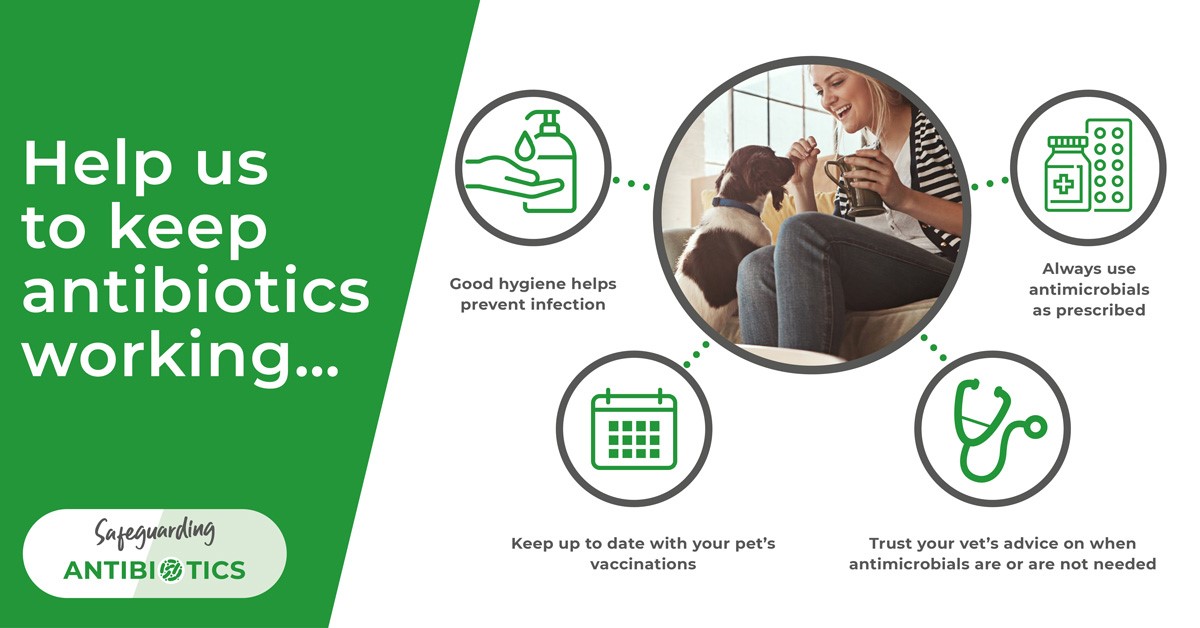
What is antibiotic resistance?
Antibiotic resistance occurs when bacteria develops mechanisms to reduce the effects of the antibiotic. These mechanisms evolve through mutation and adaptation. Mutations can be good or bad for bacteria. In some cases, the mutation kills the bacteria and it may provide the bacteria with a survival advantage. The survival advantage may include resistance to antibiotics. In the presence of antibiotics, this resistance becomes an advantage and the resistant strain becomes dominant.
In pets, just like in humans, it's normal to have bacteria in the bowel and on the skin. These bacteria, just like any other, can develop resistant mechanisms, so using antibiotics can kill other non-resistant bacteria, allowing the resistant bacterial strains to dominate and thrive. As a result, overusing antibiotics or use of an antibiotic over an extended period can affect the 'good bacteria' and cause more harm than good.
Antibiotics are only effective against some types of bacterial infection and will not work against viral infections. Therefore, veterinary surgeons need to determine what kind of infection a pet may have to treat and help them recover quickly and safely as appropriate. Following your veterinary surgeons' advice on medication, it's essential to ensure long-term access to antibiotics that work.
Why do we need to alter the overall attitude towards antibiotic use?
Bacterial resistance to antibiotics is a One Health concern. If this important class of drugs becomes ineffective, it will have a serious impact on the health of both humans and animals.
For years now, alongside other infection control measures in human and veterinary medicine, antibiotics have been a core feature of providing effective medical treatment for bacterial infection. As a result, infections that were once fatal are now treatable and surgical procedures have become more advanced due to our ability to treat infections.
In recent years, however, the medical and veterinary professions have identified that the effectiveness of antibiotics against some bacteria has changed. We know this because the bacteria which can resist antibiotics are seen more often. To slow down the evolution of resistant bacteria and protect the efficacy of the drugs, medical professionals have had to review their approach to using these antibiotics, whilst research to find new antibiotics is ongoing.
How does antibiotic resistance occur?
After Alexander Fleming discovered penicillin in 1928, work was undertaken with his colleagues Florey and Chain to make the molecule useable as a drug to treat infections in people. Fleming himself noted in his early observations that bacteria could become resistant to penicillin, even if used appropriately.
Understandably, given its significant impact on healthcare, penicillin was initially prescribed widely, but it became less effective over time.
A combination of factors has contributed to this. Some of these include:
- Bacterial multiplication, mutation and evolution (natural processes)
- Use of antibiotics for non-infection control reasons
- Prescribing antibiotics 'just in case' for illnesses may speed the development of resistance
- A significant reduction in the availability of novel antibiotic classes.
What does this mean?
Research for new antibiotics is an area of focus that has Government support. However, the development and approval process for any new drug takes time. While this research is ongoing, we need to take measures to slow down the evolution of resistance and protect the drugs' efficacy.
This means that, as some antibiotics are no longer as effective as they used to be, healthcare and veterinary professionals have had to adapt their approach to administering antibiotics to help preserve the efficacy of those that currently still work. This work has resulted in significant drops in antibiotics used. The Veterinary Medicines Directorate reported a reduction in antibiotics in food-producing animals in the UK of 52% in six years (between 2014 and 2020).
We should also be aware that any new antibiotics discovered may be reserved for human use instead of antibiotics for our animals.
Why is it important for veterinary medicine?
As antibacterial resistance is a growing concern in both human and animal medicine, there is pressure to preserve the medical use of certain antibiotics. This has implications for animal health and welfare. Veterinary professionals, therefore need to use antimicrobials responsibly. Using antibiotics only when appropriate also reduces the chances of drug side effects and reduces the carbon footprint of treating diseases.
In both human hospitals and veterinary practices, it is common to find recommendations for infections or conditions where antibiotics are not required. This is called Antibiotic Stewardship.
Our practice supports the British Small Animal Veterinary Association (BSAVA) and the Small Animal Medicine Society (SAMSoc) 'PROTECT ME' principles. Their core principles are as follows:
Prescribe only when necessary
Reduce prophylaxis
Offer other options
Treat effectively
Employ narrow spectrum
Culture appropriately
Tailor your practice policy
Monitor
Educate others










We are one of the UK’s leading Specialist Orthopaedic, Spinal and Soft Tissue small animal referral centres.